What problem was Gains trying to solve?
Social casinos face a unique mix of fraud vectors. Gains was fighting abuse across three core areas at once:
- Promotion abuse: Gains offers compelling incentives, including a 150% welcome bonus and a 100k token referral bonus. These promotions attracted bad actors creating multiple accounts to farm rewards.
- Chargeback payments: Fraudsters attempted to fund accounts using stolen or disposable credit cards, then initiated chargebacks after extracting value.
- Redemption Abuse: Paying out fake users and multi-accounters would have cost Gains hundreds of thousands of dollars in redemption losses.
What was Gains using before Verisoul?
Gains relied on a fraud product bundled with its payment provider. While it technically covered chargeback risk, it wasn't tuned for social casino traffic and introduced major tradeoffs:
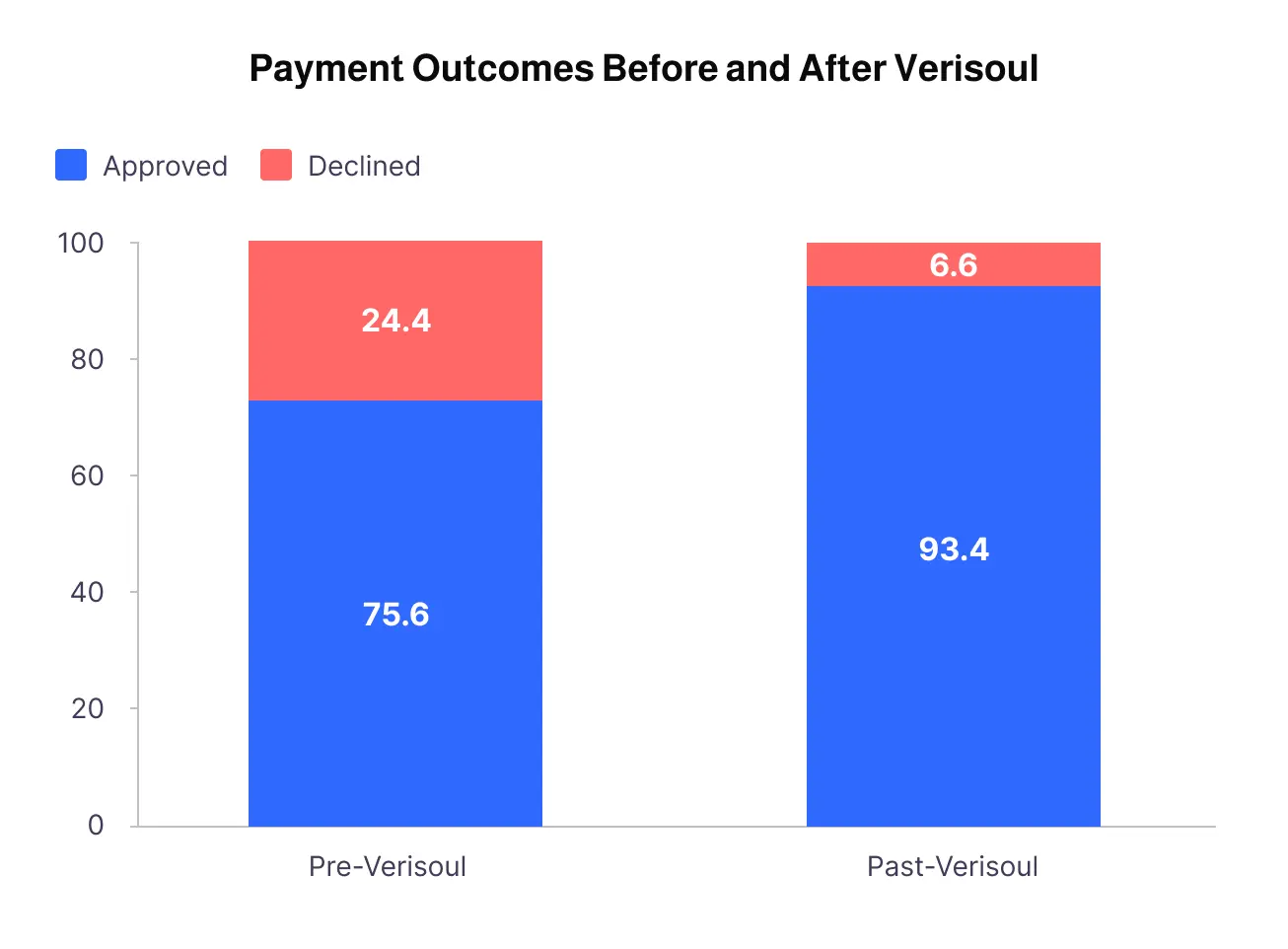
- High Decline Rate and False Positive Rate: 24% of transactions were declined, indicating the tool was blocking a massive amount of potential revenue.
- High Cost: The solution cost ~$0.75 per transaction.
- Trust Issues: Legitimate users were frequently blocked, suppressing revenue and hurting player trust.
Why did Gains choose Verisoul?
Gains needed a solution that could address multiple risk vectors without stitching together multiple point solutions. Verisoul stood out because it addressed account integrity, promotion abuse, payment risk, and redemption fraud in a single system.
How does Verisoul’s account-level signals outperform payment fraud models?
Most payment fraud systems are built around single-session payment risk. They evaluate a transaction in isolation (Credit Card + IP + User Agent) and decide whether to block it. That approach misses the broader picture of who the user actually is.
Verisoul evaluates account-level risk, using longitudinal signals that compound in accuracy:
- Identity Signals: Email age, reputation, and reuse across accounts.
- Behavioral Signals: Registration velocity, signup patterns, and in-game behavior consistency.
- Longitudinal Data: Risk scoring that improves over time instead of resetting every session.
This gives Gains a durable understanding of whether an account is a real player or a professional fraudster.
How exactly does Gains use Verisoul in production?
Because Gains controls its full infrastructure stack, the team integrated Verisoul natively alongside KYC and payments.
Their workflow looks like this:
- Signup: (prevented >$100K of bonus abuse)
- Verisoul evaluates every account and assigns risk signals in real time
- Users that Verisoul detects as linked to previous signups do not get sign-up bonuses
- Payments: (chargeback rate down to 0.11%)
- High-risk users are restricted to instant-settlement crypto payments, eliminating chargeback exposure
- Low-risk users retain access to traditional payment methods like Credit Card
- Completely removed reliance on other 3rd party fraud system
- Withdrawals & Redemptions (increased company margins by 7%)
- The fraud team uses Verisoul daily to monitor traffic and manually review edge cases
- Users connected to other accounts (multi-accounting) or known abusers are blocked from withdrawals and redemptions.
Crucially, Gains turned off the payment provider’s fraud system entirely and shifted decision-making upstream to the account level.




.webp)







.jpg)